You can want a particular school district without wanting to buy a house there. Sean O'Dowd's Scholastic Capital has built a rental strategy around that gap: buy single-family homes in districts it considers desirable, then rent them to families. For a household weighing the same choice, the useful question is how the available lease compares with the full cost of buying.
What the firm says it does

Scholastic Capital describes its focus as buying and renting homes in elite school districts. Its current website identifies O'Dowd as founder and CEO. The company says families' interest in schools can lead to longer, steadier tenancies. That's the firm's explanation of its business; it doesn't establish that every tenant saves money or that investors are guaranteed a return.
Look at the actual rental

A company strategy won't tell you what's available for your move. Ask for the address, monthly rent, deposit, fees and proposed lease before comparing it with a home for sale. Check the move-in date too. A property that fits the budget but becomes available after the school year begins may leave you paying for temporary housing or moving twice. Ask which charges are refundable, when each payment is due and what happens if the property is not ready on time.
Start with the school's answer

Confirm the address with the school district before paying a deposit. Naperville District 203's enrollment process, for example, requires proof of residency alongside other documents. That is one district's process, not a promise about every rental. Ask the relevant district which school serves the address, what documents it needs and when enrollment can be completed.
Visit the route your family would use

A listing's neighborhood description won't show you the whole daily trip. Walk or drive the route to school, look at crossings and ask about transport. Visit the nearby playground if that matters to you. A speed-limit sign is one detail to check; it doesn't prove a street is safe or that the home suits your family's needs.
Compare properties you would really choose

Put a realistic rental beside a realistic purchase in the same search area. Match bedrooms, condition and commuting needs as closely as you can. Comparing a small apartment with a much larger house can exaggerate the apparent saving. School ratings alone also won't tell you how a particular program or classroom fits your child.
Give your time horizon a number

The CFPB's rent-versus-buy guidance asks you to consider how long you expect to stay. A family planning a move after graduation faces different costs from one settling in for many years. Write down your likely stay, then test a shorter and longer version. Plans change, and buying or signing a lengthy lease can make an early move expensive.
Use a current loan quote
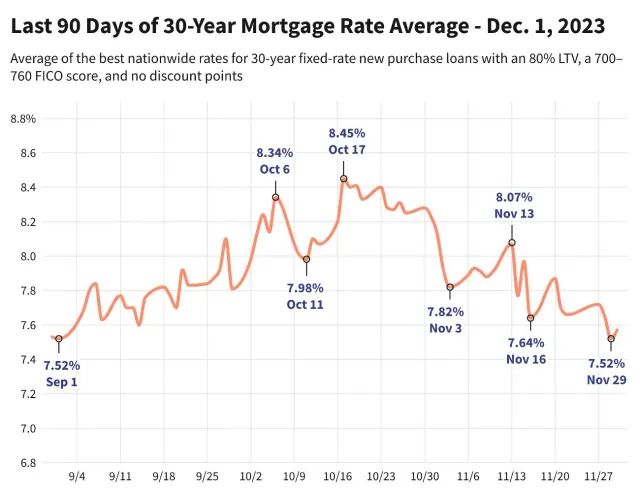
The mortgage chart retained with this story is dated December 1, 2023. It shows a historical rate series, not today's borrowing cost or an offer available to you. Get a dated quote for the loan you would actually use. Compare the rate, term, points and closing costs together rather than carrying an old national average into your budget.
Add the costs beyond principal and interest
A mortgage's principal-and-interest payment isn't the whole ownership bill. Add property taxes, homeowners insurance, any mortgage insurance and applicable association charges. Allow room for maintenance and repairs as well. On the rental side, include required fees, utilities and renters insurance where relevant. Check which expenses each advertised monthly figure already includes so you don't count them twice. Keep a separate allowance for uncertain expenses instead of treating every estimated bill as fixed for the entire time you live there.
Separate upfront cash from ongoing cost
Suppose a hypothetical $1 million purchase uses a $250,000 down payment. That is 25% of the price, leaving $750,000 to finance before closing costs. A hypothetical $3,000 monthly rent totals $36,000 over twelve months, before other charges. These are arithmetic examples, not local market quotes. A down payment also becomes equity; it isn't the same kind of expense as rent.
Read what happens after the first term
Ask how renewal works, what rent changes the lease permits and what happens if you need to leave early. Get the landlord's answers in writing and compare them with the agreement. If staying through graduation matters, a cheap first year won't answer the whole question. You need to understand the later years and the cost of another move.
Decide using the written offers

Bring the lease, school confirmation and loan estimate into the same comparison. Include the cash you'd need at the start and the recurring costs you can support from income. Buying can build equity, but values can fall and repairs are yours to fund. Renting may fit a shorter stay, though it comes with the terms and renewal risks of the particular lease.