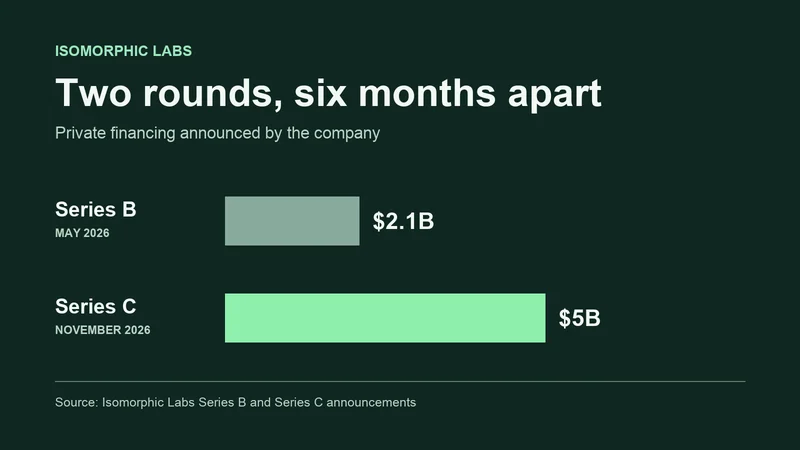
Isomorphic Labs announced a $5 billion Series C on Nov. 17, six months after raising $2.1 billion. Greenoaks and Sequoia Capital co-led the round. Andreessen Horowitz joined, and Alphabet invested again. BioSpace reported that it was the largest private biotech fundraise on record.
The headline figure belongs to Isomorphic, a private drug developer. If you own Alphabet shares, you have indirect exposure through the parent company. You own no Isomorphic shares through that purchase. And the size of the round gives you very little to work with if you want to know how much of Alphabet's business depends on it. Isomorphic's announcement leaves out how much Alphabet contributed, what percentage it owns after the deal and what price the deal put on the whole company.
Who put up the $5 billion?
Alphabet is one participant in a group. Isomorphic also listed returning investors Thrive Capital, MGX, GV, CapitalG, Temasek and the UK Sovereign AI Fund. GV and CapitalG are Alphabet venture arms. Reading their names separately on the participant list doesn't give you three figures you can add up. The release doesn't break out what any individual investor paid.
The May Series B announcement named Thrive Capital as the lead and Alphabet among the returning investors. The $5 billion in this week's announcement is more than twice that round's $2.1 billion. That's a comparison of cash raised across two financings. The releases give no basis for saying the company doubled in value or that Alphabet doubled its stake. To work either of those out, you'd need terms such as the price investors paid and how many shares were issued, plus Alphabet's holdings before and after.
The funding amount and a valuation answer different questions. A round tells you how much financing the company announced. A valuation estimates what the equity is worth at a particular moment. Even if you had an agreed valuation for the whole company, you'd still need to know Alphabet's ownership and the terms of its shares to estimate the value of that holding. Isomorphic disclosed none of those terms in Tuesday's release.
Where the company says the money will go
Isomorphic says it plans to use the financing to improve the software it uses to design potential medicines, advance its own and its partners' research programs and expand the infrastructure supporting that work. There is no spending breakdown in the announcement. It doesn't say how much is earmarked for trials, how much will go to computing and staffing, or what the company's annual spending will be. Those details would matter if you wanted to estimate how long the extra cash might last.
Isomorphic already has a way to bring money in through drug research agreements. Its 2024 announcements with Lilly and Novartis illustrate how those agreements work. The company said Lilly would pay $45 million upfront and could pay up to $1.7 billion in performance-based milestones, excluding royalties. Isomorphic said Novartis would pay $37.5 million upfront and could pay up to $1.2 billion in milestones, also excluding royalties. Those were the original announced terms. The maximums depend on work reaching specified milestones, and the announcements establish the terms at signing. They don't show what the partners have paid since.
A research payment is economically different from a financing round. A pharmaceutical partner can pay for particular work or for rights under a deal. A financial investor puts capital into the company in exchange for an ownership interest or other rights under the financing terms. A sale of a medicine would bring in another sort of revenue altogether. The $5 billion number tells you how much financing Isomorphic announced. It doesn't measure the income from any of that work.
What Alphabet shareholders can see
Alphabet's quarterly filing with the SEC lists two classes of ordinary shares that trade on Nasdaq. Class A trades as GOOGL and Class C trades as GOOG. Both are shares of Alphabet, whose businesses also include Google Search, YouTube and Google Cloud. There is no separate Isomorphic Labs ticker on a public exchange. Alphabet's participation links the two companies financially, but the announcement provides too little detail to calculate how much Isomorphic exposure an Alphabet share represents.
Alphabet's most recent quarterly report covers the three months through Sept. 30, so Tuesday's financing falls outside that period. In the report, Alphabet grouped its long-term businesses outside Google into Other Bets. That group recorded $372 million in quarterly revenue and an operating loss of $2.047 billion. Neither figure tells you how much cash Isomorphic uses or what it earns from drug research. Waymo and other businesses contribute to that same group, and Alphabet says the group's revenue came mainly from autonomous transportation and internet services.
The next set of filings could shed light on the investment if Alphabet reports a material effect. Even then, a figure for all of Other Bets would still tell you about the group. A change in that line could reflect operations elsewhere in the segment, regardless of how Isomorphic's programs are progressing.
What still has to happen in the clinic
Isomorphic's financing release describes its programs as preclinical. That means the evidence it presented with the round concerns work before testing in people. The FDA's overview of drug development treats discovery, preclinical research, human studies and regulatory review as distinct steps. A first human study would tell readers a program had crossed one of those thresholds. Later studies would have to answer different questions, including whether a potential drug helps patients and what risks come with it.
That matters for the business because a program can take more time and money at each step, and some programs will stop. Isomorphic also has to show whether the approach can work across multiple projects. Announcing a trial for one candidate would give the public something specific to follow, such as what the study measures and when it expects results. It would offer much less information about the company's other programs or how quickly partners might owe their next payments.
As of Tuesday, the confirmed change is that Isomorphic announced another $5 billion in financing and Alphabet took part. The next figures that would explain much more about the business are actual milestone payments, any new disclosure about Alphabet's stake and results from human studies when they become available. Each comes from a different record, and each answers a question the financing announcement leaves open.