Start with the form in front of you
You have a benefits portal open, a deadline on the calendar, and two account names that sound like the same thing. The practical question is not which account is best in general. It is which rules in your employer's materials apply to your household, and which dates you will have to meet if you say yes.
A health flexible spending arrangement (FSA) reimburses eligible medical expenses. A health savings account (HSA) belongs to its owner. A general-purpose health FSA can make someone ineligible to contribute to an HSA even with a qualifying high-deductible plan. A limited-purpose health FSA can be compatible if the person meets the other HSA rules.
The rules below come from IRS Publication 969 (2025 edition) and describe US federal treatment. Where that source is silent, this article says so and points you back to your plan documents, which you should check before you elect anything.
Meet the Riveras, an invented household. Both adults work, and one receives an enrollment packet listing a health FSA and an HSA. The example follows that adult’s election and reimbursement, with made-up dollar figures to show how the deadlines and balances work.
Who owns the balance
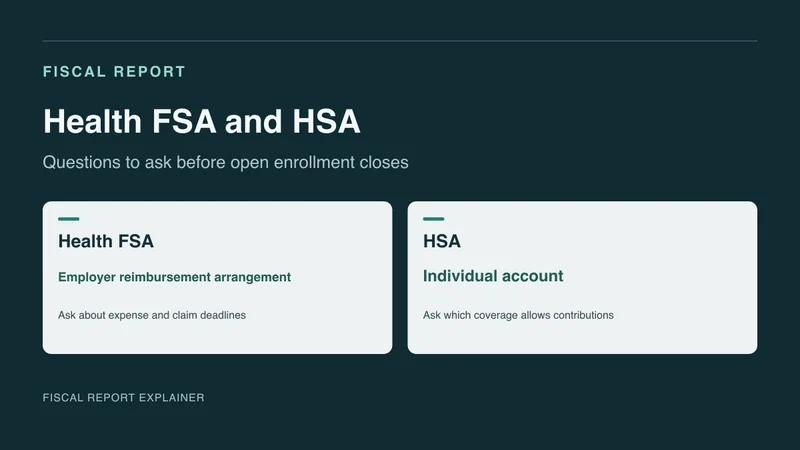
Start with who holds the account. A health FSA is an employer-established reimbursement arrangement. Employees often elect salary reductions to fund it, and employers can contribute too. A qualified claim can be reimbursed up to the elected amount before all payroll deductions occur, subject to the plan rules. An HSA sits on the other side of that line. It is an individually owned trust or custodial account, not an employer arrangement.
Say the Riveras elect $1,200 for the year, taken as $100 from each of twelve monthly paychecks. In month two they file a $400 qualified claim. Because reimbursement can run up to the elected amount, the plan may pay the full $400 even though only $200 has been withheld. That timing matters if you expect a large bill early in the year, so look for it in your plan's rules, which decide whether it applies to you.
An HSA works differently. It is an individually owned trust or custodial account. Unused money stays in it, and the account is portable. Ownership is also separate from eligibility, because being unable to contribute does not by itself stop you from using existing HSA funds for qualified medical expenses.
Set side by side, the difference is plain. The FSA is set up by the employer and reimburses claims against an elected amount under plan rules. The HSA belongs to an individual, and its unused balance stays with that person. That difference explains why year-end looks so different for the two accounts, which the section on dates takes up.
When a health FSA can block HSA contributions
The IRS requires qualifying high-deductible health coverage to contribute to an HSA. Check Publication 969 for the definition of that coverage. The IRS also lists three other general conditions: no disqualifying additional health coverage, no Medicare enrollment, and no eligibility to be claimed as another taxpayer’s dependent.
The part to check in your benefits packet is what the FSA reimburses. A general-purpose health FSA that reimburses qualified medical expenses usually conflicts with HSA contribution eligibility. A limited-purpose health FSA restricts what it reimburses. The IRS gives categories such as dental and vision care, and it allows certain preventive care. Ask the plan administrator what the arrangement reimburses if the packet gives you only a name.
Return to the Riveras. Assume the adult who would fund the HSA has qualifying coverage and is also the one who would enroll in the employer's FSA. If it is a general-purpose health FSA, that adult's HSA contributions are probably off the table while the FSA applies. If it is a limited-purpose FSA instead, contributions can stay possible, depending on its terms. The plan's terms matter more than the account's nickname. Whether one spouse's general-purpose FSA affects the other spouse's HSA eligibility is not settled by the sources used here.
This is a list of general conditions, not a catalog of every 2026 or 2027 exception. If the materials describe an unfamiliar arrangement, ask the plan administrator which category it falls in.
Two dates and one balance that are easy to mix up
At year-end, look for two separate dates in the benefits materials. The first is the last date to incur a covered expense. The second is when to file a claim for a covered expense that already happened. Read the benefits packet for the filing deadline and ask the plan administrator to confirm it if the document is unclear. Once the dates are clear, ask what happens to any money left over after eligible claims are paid.
Unused health FSA money is generally forfeited. A plan may offer a carryover or a grace period of up to two and a half months. A health FSA cannot offer both. The examples below show how each provision can affect reimbursement. For a carryover amount, look up the limit in the specific plan materials.
Take the Riveras’ $1,200 election. They have used $950 by the end of the plan year and have $250 left. Say a covered $90 dental visit happens on the final day of the plan year. They send the claim a few weeks later. If their filing window is still open and the claim is paid, $160 remains. That case separates when the expense happened from when they asked to be reimbursed.
Move that same visit to a week after the plan year ends. A grace period that covers the expense can let the Riveras use last year’s money, leaving $160. If their plan has a carryover instead, the plan’s terms determine how much of the $250 is available for next year’s expenses. In a plan with neither feature, the Riveras would pay the $90 themselves, and the unused $250 would be forfeited once the time to submit old claims had passed. That case tests whether the new expense is timely.
For the ownership question, imagine a $250 HSA balance at year-end instead. That $250 stays in the HSA. For eligibility to add money to it, Publication 969 allows coverage during a general-purpose health FSA grace period if the prior plan-year FSA balance was zero. The Riveras’ illustrative FSA balance is $250 at year-end. This example tracks reimbursements and has no outcome for their HSA eligibility. Ask the administrator how a positive FSA balance or a carryover would affect that eligibility.
Dependent care and the limits of this reporting
A dependent care account is separate from a health FSA. IRS Publication 503 (2025) identifies an employer dependent care flexible spending arrangement as a separate source of dependent care benefits that can pay for eligible care while working. The sources used here do not address how it interacts with HSA eligibility, so this article makes no claim on that point. Find its election and deadlines in your materials, and read that section separately.
The reading approach can also fail when coverage changes. If you share coverage with a spouse or expect to change jobs during the plan year, give the administrator the coverage and employment dates before making an election. Ask which rules in the packet apply to that timeline. A qualified tax professional can help with any tax question the administrators cannot answer.
It fails most plainly when the materials are vague. If a plan's description never says whether an FSA is general purpose or limited purpose, you cannot classify it by guessing. Until someone answers in writing, treat your HSA eligibility as an open question. A vague answer is still information, because it tells you what to ask next.
A bounded next step
Pull the benefits summary and find four things. First, what the health FSA will reimburse. Second, whether the plan uses carryover, a grace period, or neither. Third, the last day to incur an eligible expense. Fourth, the last day to file claims for expenses already incurred. If you are leaving the job, ask your administrator separately about the claims and balance rules that apply at departure.
The objection is fair. Reading plan documents costs time, and open enrollment lands when work is already busy. A quick pass will not catch every exception. If you can do only one thing, confirm the FSA type. Start with the coverage description in the plan materials. Ask the plan administrator if it leaves the FSA type unclear.
This step is unsuitable as a substitute for personal tax advice. It also will not settle the question if you are enrolled in Medicare or can be claimed as someone else's dependent, since those conditions affect HSA contribution eligibility whatever the FSA type.
If you are making this decision on an uneven income, write down the amount you can set aside each paycheck and the dates when you usually have medical expenses. Compare those dates with the filing and spending deadlines you found in the packet. If that timing leaves you with more questions, ask the plan administrator to point to the sections that answer them. Bring the coverage dates and the name of the FSA arrangement so the administrator can check eligibility against the right plan. Try to get the date and the rule in writing before open enrollment closes.