Eligibility comes first
Your first move comes before any paycheck changes. Find out when you become eligible for the employer's 401(k) plan, and ask whether you must sign up or are enrolled automatically. The IRS describes a 401(k) in its 401(k) plan overview as an employer plan under which employees can elect to defer compensation. Employers may also contribute. The same page says plans can vary. The IRS vesting guidance points readers to their plan documents for their own vesting terms. The document to request is the Summary Plan Description, or SPD. The IRS guide to plan disclosures says the SPD covers eligibility, contributions and vesting. It also explains why you should use the terms of your own plan. The IRS vesting guidance adds that employers can count service in different ways, so ask the plan administrator how your own years of service are counted. Four terms to find in it, or to ask the plan administrator about: the eligibility date, the match formula with its definition of eligible pay, the vesting schedule, and whether a Roth option is offered. The eligibility date tells you when to start looking for a deferral on your pay stub. A Roth option raises a separate question about the timing of federal income tax. That is worth carrying into your first benefits meeting, because a 401(k) is less a single product than a family of rule sets, and your employer chose one.
Start with a few practical questions. When can you begin deferring pay? What date or service does the administrator use for the vesting schedule? Does the plan offer a match or designated Roth deferrals? Keep the administrator’s answers together so you can match the dates to the terms in your plan materials.
Deferral and match are separate money
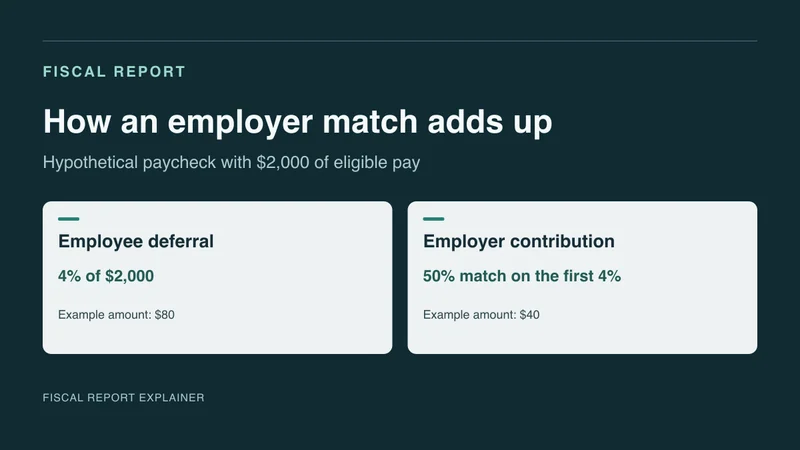
A deferral is the part of your pay you elect to send to the plan instead of receiving it in the paycheck. It is your money, taken at the source by payroll. A match is different. It is an employer contribution, and the IRS overview says employers may contribute. If a plan has a match, ask where its formula is stated, and which pay it counts. The employer in the example below uses a formula tied to what the worker defers. Two working terms help before the example. Eligible pay is the pay the plan counts when it applies a percentage. Matchable deferral is a working label for the portion of your deferral the formula will match. Your plan may define both differently, and the definitions can change the arithmetic.
That is the practical risk of a casual reading. Take the hypothetical plan traced next, which matches 50% of deferrals, up to the first 4% of eligible pay. Under that formula, a worker who defers 6% of the same eligible pay gets the same match as one who defers 4%, because the formula stops at the first 4%. The percentage on your pay stub is a fact about you. The match is a fact about the plan. Neither one answers the other without the document in front of you.
One hypothetical pay period, traced
Take a hypothetical plan with invented definitions that may differ from real plans. Market movement is ignored. Suppose eligible pay for one pay period is $2,000, and the employee defers 4%. Four percent of $2,000 is $80. Suppose the plan matches 50% of deferrals, up to the first 4% of eligible pay. The first 4% of eligible pay is also $80, so the matchable deferral is the full $80. Fifty percent of $80 is $40. In that pay period, $120 enters the plan, with $80 from the employee and $40 from the employer. The IRS vesting guidance says workers are always vested in their own elective deferrals, so the $80 belongs to the employee. The $40 is where the plan's vesting terms come in.
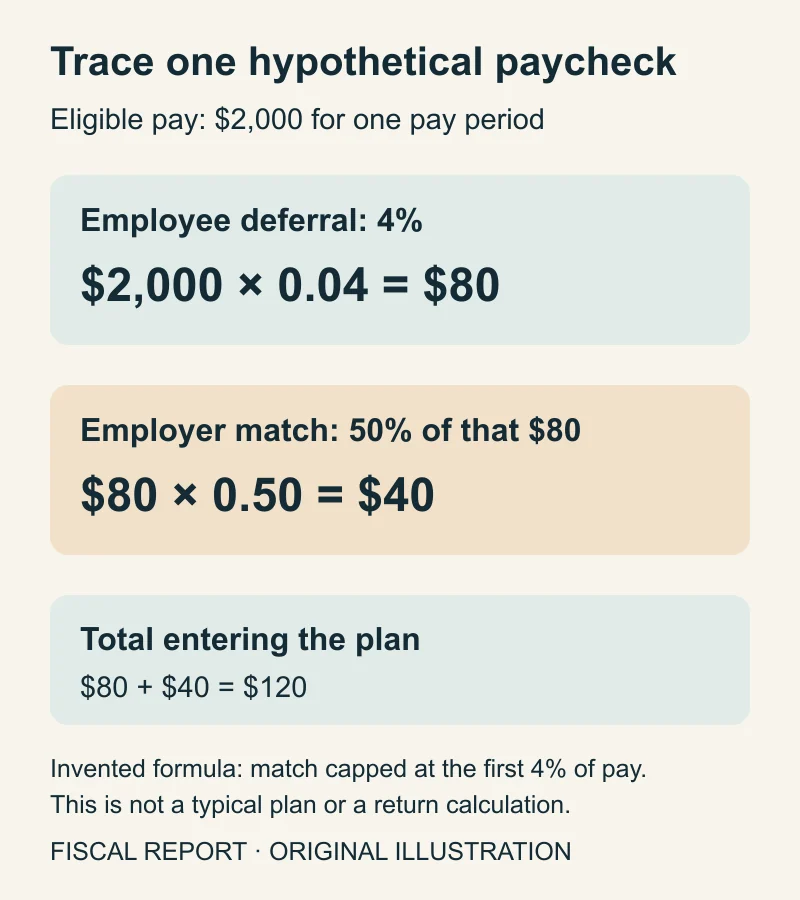
Change one input and the result moves. If the same employee deferred 2%, that is $40, and the match would be $20. If the employee deferred 6%, that is $120, but this hypothetical plan's match formula only reaches the first $80 of deferrals, so the match stays at $40. The extra $40 of deferral would still be the employee's, and it would earn no match under these hypothetical terms.
Vesting decides how much of the match stays
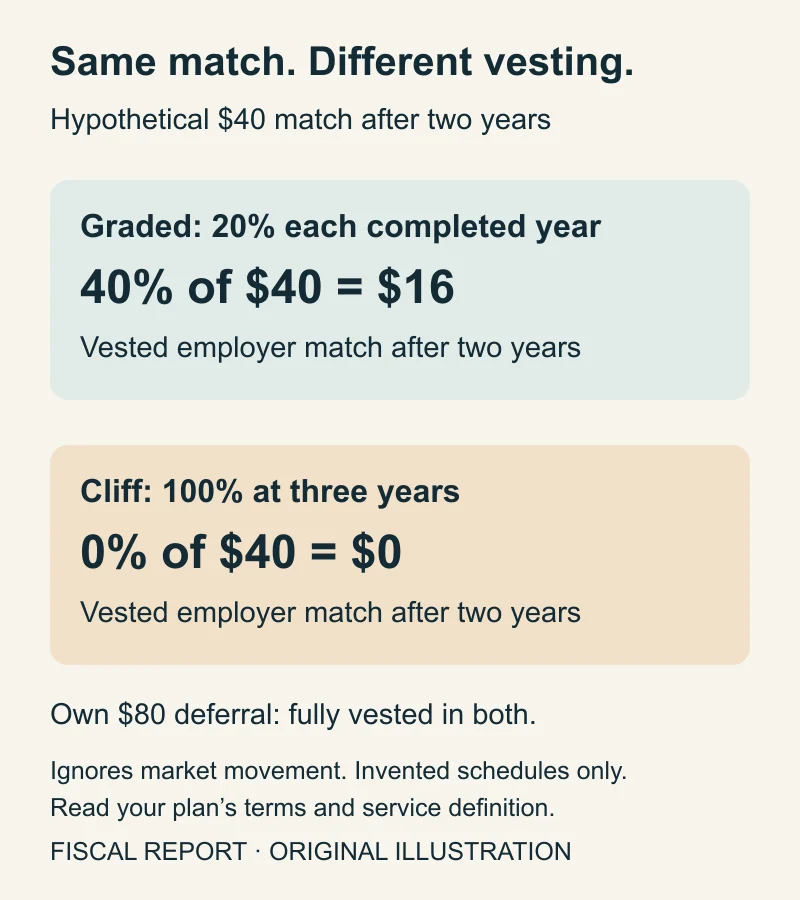
Vesting is the share of an employer contribution that belongs to you. The IRS vesting guidance says qualified defined-contribution plans can use different schedules for employer contributions, and that plan documents define the terms. It points readers to the Summary Plan Description or the employer for those terms. Now model one employer amount, the $40 match from the example, again ignoring market movement. Suppose this hypothetical plan uses a graded schedule that vests 20% for each completed year of service. After two years, 40% is vested, which is $16. The other $24 is not yet the employee's. After five years, the schedule reaches 100%, so all $40 is vested. These are invented percentages, and a plan could count service differently.
Suppose, as a second hypothetical, the plan used a three-year cliff instead, meaning none of the match is vested until the employee completes three years of service, then all of it. An employee who leaves after two years would keep the $80 deferral from this pay period and none of the $40 match. The same departure under the graded 20% schedule would keep $16 of it. Under either hypothetical schedule the employee is fully vested in their own elective deferrals. The vesting schedule changes the employer amount they keep.
Traditional and Roth deferrals differ on tax timing
If your plan offers a designated Roth option, it adds a choice about how your elective deferral is treated for federal income tax. Whether yours does is a question for the plan administrator. According to the IRS Roth comparison chart, traditional pre-tax deferrals and designated Roth deferrals differ in when federal income tax applies. Roth deferrals are after tax, and certain qualifying distributions are tax-free. The word qualifying matters, because the tax-free treatment depends on conditions beyond that basic timing difference.
In the worked example, the $80 is the same elected deferral either way. What differs is when federal income tax applies. Whether that changes take-home pay differently is a tax-timing question that depends on individual circumstances. The employer match in the example is a separate item, and whether any match can be designated Roth is an open question for the plan administrator. A tax professional or the plan's own materials are better placed to say which option fits a given person.
Use the plan summary and ask the administrator
The IRS points readers to the Summary Plan Description or their employer for vesting terms. Use the summary to find when participation can start and when benefits vest. Because the IRS vesting guidance says employers can count service in different ways, ask the plan administrator how your years of service are counted. Then ask the plan administrator for the employer match formula and its definition of eligible pay, wherever the plan lists them. Ask separately whether the plan offers designated Roth deferrals. With those details in hand, you can change the inputs in the $2,000 example and see which terms affect each amount.
The practical objection is fair. A match shows up now, while a vesting cost shows up later, perhaps at a job change, and deferring lowers take-home pay today. Which tradeoff suits you depends on your own plan terms and circumstances. Request the plan summary for participation and vesting. Ask the administrator for the match formula, the definition of eligible pay and any designated Roth option. That step is not enough if the SPD conflicts with the benefits portal or seems dated. Then ask the plan administrator which document is current and which controls if they differ. Under the hypothetical schedules, both the match formula and the vesting schedule change the amount of employer money the worker keeps. The employee is fully vested in their own elective deferrals under either schedule. The next step is yours, and the administrator's dated written answer is what would settle it.