Start with the fee line
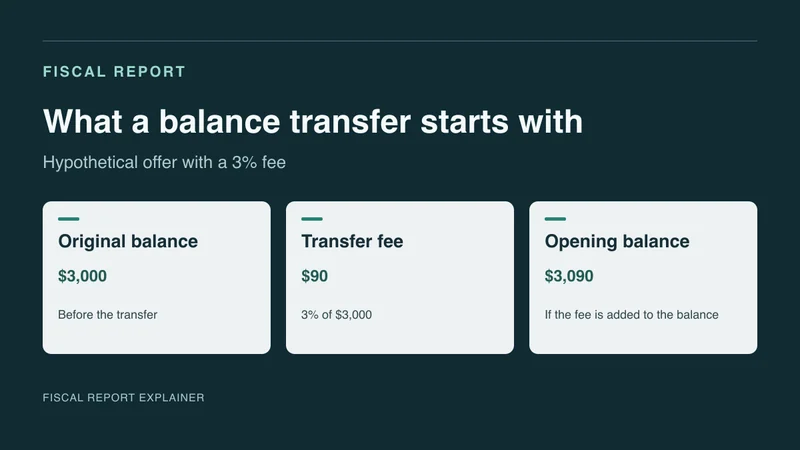
Which condition weakens a balance transfer offer depends on how you use the card. If you will keep buying on it, test the purchase-interest rule first. If you cannot reach the monthly payoff figure worked out below, check the promotion end date and the APR listed for the period after the offer ends. Either way, find the line on the offer labeled balance transfer fee, and read it before you read the promotional rate. The Consumer Financial Protection Bureau, a U.S. federal agency, says issuers can charge a transfer fee even when the promotional APR is zero percent. APR means annual percentage rate. A zero-percent promotional offer can still carry a transfer fee, so the percentage on that fee line also belongs in the comparison. Here is a hypothetical to make the arithmetic visible. Suppose someone moves $3,000 and the fee is 3 percent. The fee is $90, and the starting balance becomes $3,090. This example assumes the fee is added to the same zero-rate balance and that no new purchases are made. Those assumptions matter, because a fee charged to a different balance, or a card that is also used for shopping, would change the numbers. The first question to ask of any offer is how much you start owing, not how little you pay in interest. If the fee is stated as a percentage, multiply it by the amount you plan to move.
Purchases follow different rules
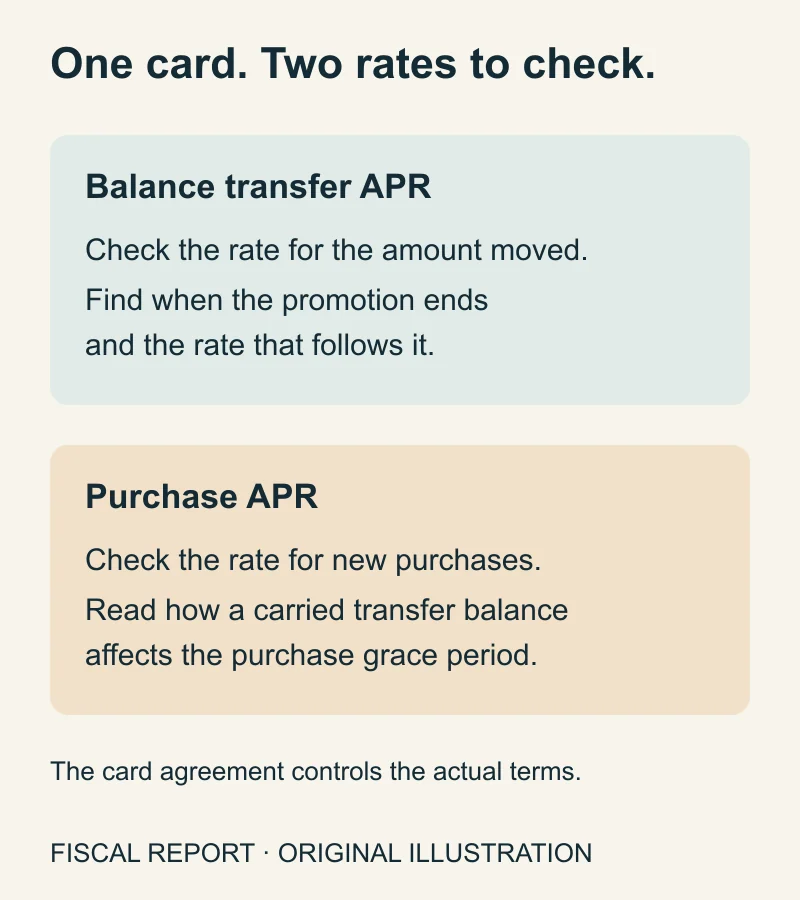
Next, find the purchase APR on the same offer. Check which transactions each advertised rate covers. The CFPB explains that cards can have different APRs for different transaction types and time periods; a promotional rate may cover only the transferred amount. The CFPB says that on most cards, carrying a balance from month to month can cause interest on new purchases from the purchase date, even if the transferred balance has a zero-percent rate. A grace period is a window in which new purchases do not accrue interest. The agency adds that paying the full outstanding balance, including the transfer, may be necessary to use a purchase grace period. In the hypothetical, that means $3,090 sitting on the account while it is repaid over time could leave a new purchase collecting interest from the purchase date instead of after a free window. Whether that happens on a given card depends on its terms. If you plan to keep using the card, read the purchase interest clause closely before you rely on the zero rate. If the card will sit unused, it matters less.
Two dates and two rates to find in the offer
Find the day the promotional rate ends and the payment due date on the statement. The first marks when the promotional rate stops. The second tells you when that month's payment is due. The CFPB's credit-card agreement explanation says each monthly statement shows the minimum payment and due date. Look for the APR listed for a remaining balance after the promotion and the purchase APR for new charges. Write down both rates as the terms give them. The rate shown for purchases may differ from the rate shown for the transfer. If you have two offers in front of you, record the dates and rates next to the fee from each one. That puts the terms in the same place before you run the numbers. The CFPB explains terms such as APR and grace period. For the dates and exact rates on your transfer, look at the offer and statement themselves.
Minimum payment is not a payoff plan
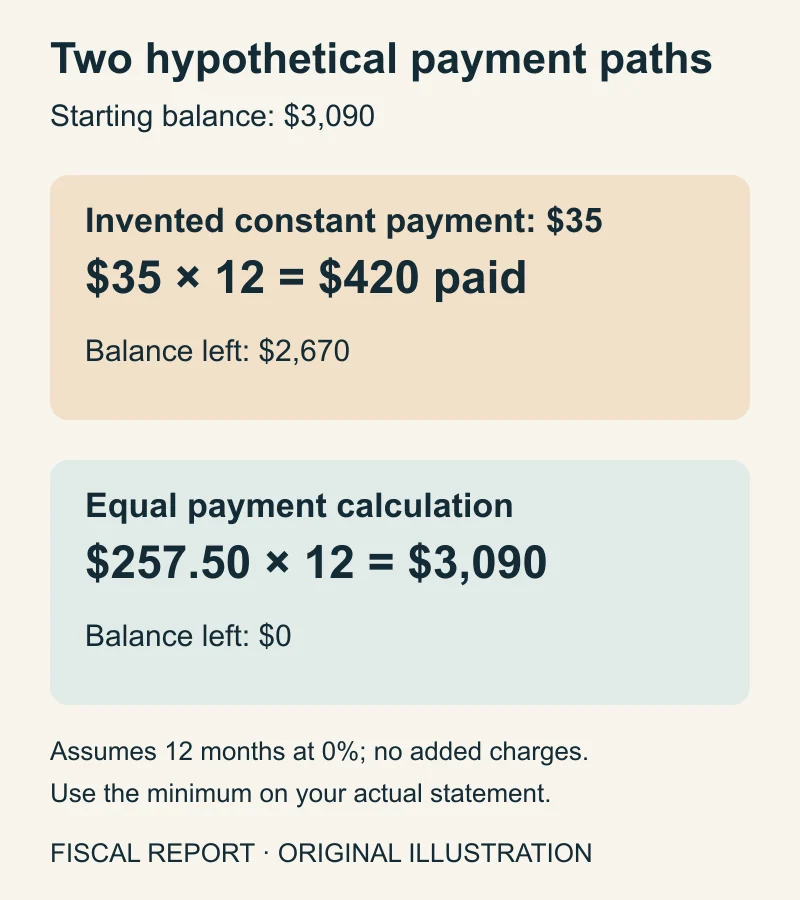
Now compare two numbers that are easily confused. Copy the minimum payment from the statement. The CFPB says each monthly statement shows the minimum payment and due date. The $35 used below is an illustration. Whether a minimum would clear the balance before the promotion ends is a separate calculation. Assume a twelve-month zero-percent period, a $3,090 starting balance and no other charges. Divide that balance into twelve equal payments. The result is $257.50 a month, and twelve payments of that size total $3,090. That schedule is an illustration, not a required minimum and not advice. Now suppose, using an invented figure and not a typical one, that a statement showed a constant $35 minimum and the promotion lasted twelve months. Twelve payments would total $420, leaving $2,670 of the $3,090, with no purchases, fees or rate changes assumed. The $35 stays constant only in this hypothetical. Use the minimum on the actual statement for a real account; the $2,670 is not a prediction for any card. The gap between $35 and $257.50 is the work the minimum does not do. Find the promotion length, divide the total owed by the months, and compare the result with the minimum on the statement. Check the promotion end date in the offer. Ask the issuer which payment dates fall inside the period if the terms leave it unclear.
Promotional APR is not deferred interest
One more distinction belongs in the comparison. A promotional APR is a reduced rate for a set period. In its example of deferred interest on a purchase plan, the CFPB says a balance left at the end of the promotion can trigger interest dating back to the purchase. That CFPB example concerns a purchase. Look for the balance transfer offer's own wording before applying anything from that example. Read the offer for the word deferred, and for any sentence that says what happens if the balance is not repaid by the end date. If the terms describe a plain zero-percent promotional APR, check the offer for the APR it lists for a remaining transferred balance. The $35-minimum scenario leaves $2,670. The $257.50 scenario leaves zero after twelve payments under the stated assumptions. If the terms describe deferred interest, ask the issuer how it calculates any charge on that remaining balance. The unresolved part is which structure a specific offer uses, and that cannot be answered from general explanations. Put any condition you cannot resolve next to the fee and the deadline. Ask the issuer to identify the line in the agreement that explains it.
Where the example stops working
A fair objection is that a tidy example hides the messy parts, and that a single hypothetical can feel more precise than it is. The $3,090 and $257.50 figures are arithmetic on assumed inputs, not a forecast of any real card, and they leave out new purchases, a missed payment and rate changes. The approach also fails in some cases. For someone who plans to keep using the card for purchases, check whether the offer gives those purchases a grace period while the transfer balance is outstanding. If you cannot reach the monthly payoff figure, calculate the balance left on the date the promotional rate ends. For a bounded next step, write down the fee, the payment due date, the promotion end date, the purchase APR, the APR after the promotion and the statement's minimum payment, then divide the total by the months available. Which condition makes the offer less useful depends on the reader. For someone who will use the card for purchases, the purchase interest rule is the one to test first, and the unknown is how the specific card applies it.